| erlangerchartroom tm ADVANCED ANALYSIS WITH THE SQUEEZEPLAY ADVANTAGE |
|
|
|||||
| Phil Erlanger Research
presents Erlanger Chart Roomtm |
Focusing on Setups and TriggersWhen entering into a trade, there are two basic types of strategy indicators: setups and triggers.
Setup indicators are designed as filters that steer the trader to moments when making a trade will result in greater success than others. Examples of setup indicators include seasonality, sentiment (a contrary setup indicator,) industry group relative performance, fundamental information (e.g. earnings momentum) and price, volume, or other “divergence” oscillators (e.g. Relative Strength Index or “RSI,” Moving Average Convergence/Divergence or “MACD,” or Erlanger Volume Swing.) Oscillators are used as setups most often when they begin to diverge from price action. For instance, if price is rising to a new reaction high unconfirmed by the RSI oscillator, a setup for a potential short sale exists.
Triggers are designed to tell the trader the exact moment to execute a trade by measuring when price begins to move (or significantly moves) in the direction indicated by setup indicators. Examples of triggers include moving average crossovers, price moving through a moving average or through a DMA (displaced moving average) channel, or a change in status of a trend direction indicator. Some indicators, like the Erlanger Volume Swing (EVS) and the MACD are used as both setup and triggers (setup when the MACD or EVS diverges with price, trigger when the MACD crosses its signal line, or when the EVS moves through the “zero” level.)
Let’s look at an example:
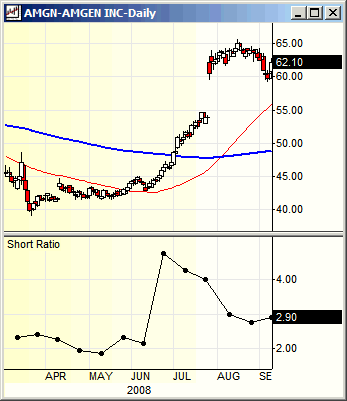
The trading process typically begins with the prelude of one or more signals from setup criteria, and then the trade is made when the market moves sufficiently in the anticipated direction to set off the trigger indicator. After the entry trade, “monitoring” indicators are used to exit the trade. In the above chart the jump in the short interest ratio in Amgen represents a significant bet against the improving action of the stock’s price. This may or may not have been a smart bet at the time for various reasons, but the market is the final arbiter in such situations. The use of trigger indicators tells the tale… in this case when the price action moves above the 200-day moving average line a long trade is triggered. This strategy identifies a short squeeze play underway when the shorts are forced to cover when the market moves against them… thus there is double the positive force at play: 1) the current fundamental reasons positively affecting the price, and 2) the extra flow of buy orders as shorts cover their losing positions.
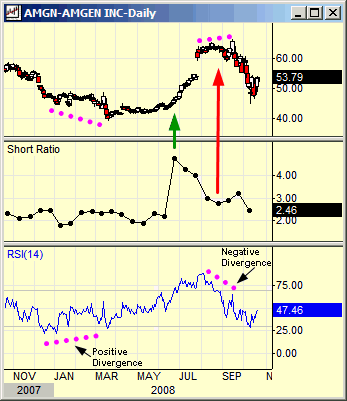
There are other setup indicators that could have been used. In the above chart the RSI oscillator diverged positively with the lower low in price in March 2008 – a positive setup. It diverged negatively with the higher high in price in September 2008 – a negative setup. The setup becomes stronger when multiple indications are present. The heavy short selling (green arrow) confirms the positive RSI divergence, and the depleted short interest ration (red arrow) confirms the negative setup.
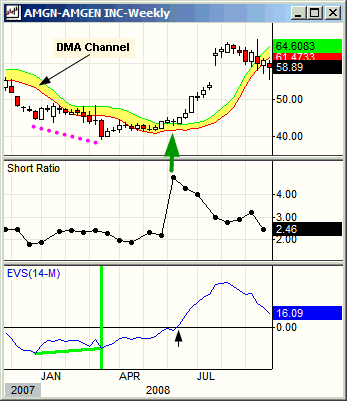
The setups and triggers can also be established on a variety of time frames. Erlanger Chart Room is specifically designed to make it easy to view factors in multiple time frames. In the above chart, the weekly price action into March 2008 shows a positive divergence from the Erlanger Volume Swing (EVS) indicator. The EVS also acts as a trigger when it moves above the “zero” line (see small black arrow in above chart.) The price action itself is a trigger when it moves above the DMA (displaced moving average) channel.
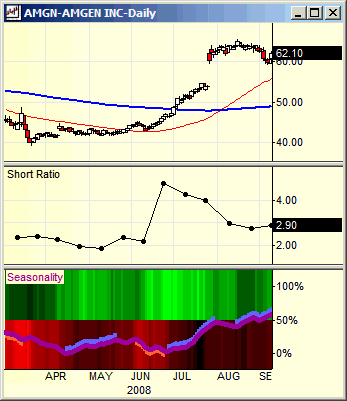
The opportunities increase when seasonality is in favor of the setup and trigger sequence. In the above chart the seasonal cycle for Amgen turns positive in late June and rises through to September.
|
Privacy Policy | Terms of Service | Earnings Disclaimer |


© Phil Erlanger Research Co., Inc., 2026.
All Rights Reserved.